Running on one Cloudflare plan: from guarding free limits to $5 a month
Plainfeed is a website that shows new videos from the YouTube channels you pick, in upload order, with no algorithmic recommendations or Shorts. At the end of the first post I said the next technical post would be about running on a single Cloudflare plan and keeping strangers from using up D1's daily limits. In the meantime I moved from the free plan to the $5-a-month plan, so this post covers both: what I did on the free plan, and the numbers after switching.
The whole backend lives in one Cloudflare account.
| Service | What it does |
|---|---|
| Pages | Static files and server functions (/api/*: feed, channel lookup, comments, sign-in and sync) |
| Two D1 (SQLite) databases | User DB (each account's channels, feeds, watched videos) and cache DB (fetched videos per channel, daily budgets) |
| One Worker | Scheduled jobs: new-video notification subscriptions every 10 minutes (with hourly stats inside), daily cleanup, and publishing scheduled posts each morning |
A few terms first.
- Rows: the unit D1 counts reads and writes in. It counts rows read or written, not queries.
- Subrequest: a call a server function makes to something else (YouTube, D1 and so on) within one invocation.
- Scheduled run: the Worker running on its own at set times (Cron).
The free plan's limits
In short: the free plan has daily limits across the whole account, and when you hit one, the server stops for the rest of the day.
These are the free limits as I noted them in October. They reset at midnight UTC (9 a.m. in Korea).
| What | Daily limit | When exceeded |
|---|---|---|
| Server function requests (Pages Functions and Workers combined) | 100,000 | Server functions stop for the day. Static files are still served |
| D1 rows written | 100,000 | Every DB query fails, so sign-in and sync stop too |
| D1 rows read | 5 million | Same |
| Outbound calls per invocation | 50 | That request fails |
For one person, that's plenty. The problem was that the feed, channel lookup and comments APIs can be called by anyone, without signing in. I built it that way so people can try it from the home page without an account.
Ways a stranger could use up the limits
In short: when I ran the numbers on October 28, one determined person could use up a daily limit in anywhere from a few minutes to a few hours.
I had a Cloudflare rate-limiting rule per IP (20 requests per 10 seconds). It stops bursts, but someone calling steadily about once a second stays under it and can still make over 80,000 calls a day from a single IP. With the structure I had then, the math looked like this:
| Path | Cost per request | Time to hit the daily limit |
|---|---|---|
| Feed for 30 already-cached channels | about 540 rows read | 2–3 hours for 5 million reads |
| Feed with real channel IDs swapped each time | about 1,100 rows written | a few minutes for 100,000 writes |
| Channel lookup and comments with URLs, videos or page tokens swapped | 1–2 YouTube API units | a few hours for the 10,000-unit YouTube quota |
Hitting a D1 limit doesn't just stop the feed. Queries to the user DB in the same account fail too, so sign-in and sync stop for the day. So I changed two things.
Fix 1: one row per channel
In short: I moved to one row per channel, so a feed for 30 cached channels now reads 30 rows.
Before, I stored a row per video and also had a time index. That meant a feed also read the video and channel info tables, about 540 rows in all. I changed it to one row per channel, with the RSS result and each video's duration and live state packed into that row as JSON. I also dropped the time index from the cache tables (D1 counts a row in each index when you write an indexed column).
| One feed request | Before | After |
|---|---|---|
| Read 30 cached channels | about 540 rows | 30 rows |
| Write for 30 new channels | about 1,100 rows | about 150 rows |
Now even if all 100,000 daily function requests were used, reads would come to 3 million rows, short of 5 million.
Fix 2: daily budgets
In short: expensive work (fetching new channels, refreshing, channel lookups, comments, fallbacks) gets a daily cap, counted both overall and per requester.
Fetching a channel for the first time still costs writes and YouTube quota. So I keep a daily budget in the cache DB and do only that much each day. Past the cap, that work is skipped and the request is answered from what's cached.
- Per requester is counted by a hash of the IP together with that day's date, keyed with a secret. The IP itself isn't stored, and the same IP becomes a different value the next day.
- Overall is approximate. If every request added to one shared row, that row alone would eat a lot of writes. For example, refreshes are counted in steps of 100, so a request that refreshed 3 channels adds 100 with a 3% chance. The average comes out the same, with fewer writes.
// Compare what a request wants to today's remaining budget: all or nothing per kind. Trimmed
for (const k of kinds) {
  grant[k] = used("all", k) + want[k] <= L.all[k]
          && used(who, k) + want[k] <= L.client[k];
  if (!grant[k]) continue;
  mine[k] = want[k];                                   // per requester: exact
  if (rand() < Math.min(1, want[k] / step[k]))         // overall: approximate, now and then
    all[k] = Math.max(want[k], step[k]);
}
If the budget table is missing or can't be read, requests go through anyway. A budget that takes the site down would cause the very thing it's meant to prevent.
What code couldn't cap: request counts
In short: server function requests are counted the moment they reach a function, so code can't reduce them.
The two fixes above put a ceiling on D1 and YouTube quota. But if requests alone passed 100,000 in a day, server functions would still stop for the day. The conclusion I wrote in the design doc at the time was "move to Workers Paid ($5 a month) when usage grows." On the paid plan, going over doesn't stop anything; you pay for what you use (about $0.30 per extra million requests).
November 7: $5 a month
In short: on the day Google approved the OAuth verification, I switched to the paid plan because I wanted to experience running a real service.
I didn't switch because I'd hit a limit. It was the day importing subscriptions with a Google account went live, and I wanted to pay for and run a service myself.
To keep the switch small, I'd already gathered every number that differs by plan into lib/plan.js. After changing the plan in the dashboard, I only set PLAN to "paid" in three places across two config files and deployed.
// Numbers that differ by plan (trimmed). Paid numbers when env.PLAN is "paid"
export const PLANS = {
  free: { maxCalls: 48,  maxFallback: 6,  websubPerRun: 40,
          budget: { all: { new_channel: 1000, refresh: 20000 /* … */ } } },
  paid: { maxCalls: 100, maxFallback: 15, websubPerRun: 100,
          budget: { all: { new_channel: 5000, refresh: 100000 /* … */ } } },
};
export const planOf = (env) => PLANS[env?.PLAN === "paid" ? "paid" : "free"];
| Number | Free | Paid |
|---|---|---|
| Outbound calls per feed request | 48 | 100 |
| Channels fetched via fallback per request when RSS fails | 6 | 15 |
| New-video notification subscriptions per scheduled run | 40 | 100 |
| Daily refresh budget (overall) | 20,000 | 100,000 |
| Daily new-channel budget (overall) | 1,000 | 5,000 |
Order mattered. Setting "paid" before changing the plan would have made feed requests exceed the free plan's 50 outbound calls and fail. Reviewing it again that day, I found one more thing: Cloudflare counts D1 calls as outbound calls too (about 8 per feed request). So I left a note in the code that if I ever go back to the free plan, the limit has to drop to 40 or lower, not 48.
Some things stayed the same. The YouTube quota (10,000 units a day) has nothing to do with the Cloudflare plan, so the lookup and comment budgets stayed the same and fallbacks only went up 1.5×. The new-channel budget went up 5×, but at about 0.32 units per channel, even using all of it comes to around 1,600 units. The number of channels per request (30) stayed too. An invocation opens at most 6 outbound connections at once on either plan, so sending several requests of 30 in parallel is faster.
What I actually used
In short: from November 7 to the morning of the 25th (about 18 days) there were about 18,300 requests, 0.2% of the 10 million included each month, and the bill is still the base $5.
I checked these on the morning of November 25 in the dashboard and with wrangler d1 info.
| Item | Used | Included in the paid plan |
|---|---|---|
| Requests (Nov 7 – morning of Nov 25, whole account) | about 18,300 | 10 million / month |
| CPU time (same period) | about 168,000 ms | 30 million ms / month |
| Paid on top | $0 | |
| Site function requests (last 24 hours) | 1,174, 0 errors | |
| Scheduled Worker (runs per day on its schedule) | 146 | |
| Cache DB writes · reads (last 24 hours) | 3,696 · 44,045 rows | |
| User DB writes · reads (last 24 hours) | 41 · 11,553 rows | |
| DB size | cache 3.99 MB · user 176 KB |
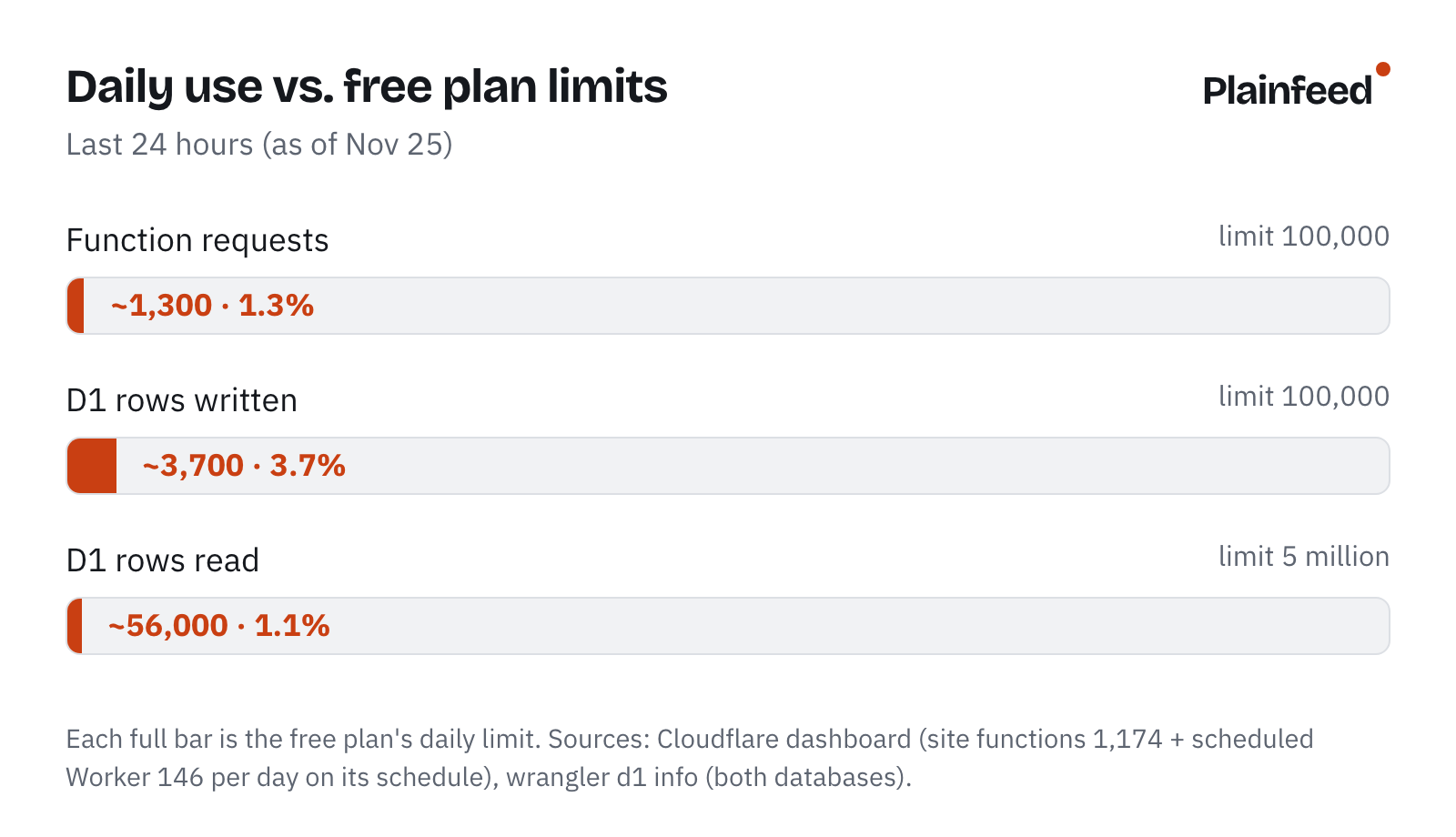
Going by current use alone, the free plan would be enough. Most cache DB writes come from the scheduled job every 10 minutes (new-video notification subscriptions) and from rewriting a channel's row when a new video comes in. I switched anyway so that the site keeps running that day even if someone hammers it or traffic suddenly grows. Going over just means paying for what's used.
Wrapping up
On the free plan my biggest worry was "it stops when it hits a limit," so I moved to one row per channel and put daily budgets in place. Request counts were the one thing code couldn't cap, so I moved to the $5-a-month plan. It's money going out every month for a personal project, but as the price of running something like a real service, I think $5 is on the cheap side.
How I saved YouTube API quota is covered separately in Living on 10,000 YouTube API units a day.