Three weeks after launching Plainfeed: 7 accounts and the questions I got
Plainfeed is a website that shows new videos only from the YouTube channels you pick, by day, without YouTube's recommendation algorithm. It's been three weeks since I published the first blog post and applied for Google verification on October 30. In that time I posted it to a few communities, and it now has 7 signed-in accounts (6 not counting mine).
This isn't a big success story. It's a record of what happened so far, with numbers: how it felt the first time someone else used it, what changed because of the questions I got, and the promotion I still haven't figured out.
Three weeks at a glance
In short: people came on the days I posted in communities, and after that someone signed up every few days.
| Item | Number |
|---|---|
| Site visits (Oct 25 – Nov 20) | about 790 |
| Visits by country | Korea about 510, US about 180 |
| Signed-in accounts | 7 (6 outside) |
| Channels in account lists | 244 (226 imported from Google) |
| Browsers that added channels and started without signing in (Nov 12–20) | 24 |
| Google verification, request to approval | 8 days |
Visits come from Cloudflare Web Analytics sampling, so they're rounded to tens, and early on they include my own visits. Accounts and channels are totals counted in the site database.
Where I posted, and what brought people
In short: community posts brought people far more than blog cross-posts, and Korean communities brought the most.
- A Korean developer community (Nov 9): Not much reaction, but at 10:36 that morning someone from outside added a channel for the first time, which, going by the time, probably came from that post. About 30 visits have come from it so far.
- A Korean AI community (Nov 10): 244 views and 9 comments as of 5 p.m. that day.
- English-language communities: I posted in a few places. Questions and a feedback email came in, so people did read them, but the analytics show almost no visits from there. That's probably because visits from an in-app browser count as direct visits.
- Blog cross-posts (velog, dev.to, Naver, note, X): they got some views, but almost no one came over to the site from them.
The first day someone else signed in
In short: even if they were just trying it out, it felt amazing that someone other than me was using something I built.
At 4:29 p.m. on November 10, an outside user signed in with Google for the first time and imported 68 subscribed channels at once. They may well have been just testing it, but I'd never shared a site like this with other people before, so it felt amazing that someone other than me came in and used it. It was a few minutes before my community post went up, so I can't say where they came from.
At that exact moment, YouTube's RSS happened to be failing, so 23 of the 68 channels showed up empty for an hour. They didn't come back during that hour. I wrote up the cause and the fix in My first signed-in user imported 68 channels and 23 came up empty. They came back the next day and added one more channel.
The questions I got, and what I changed
In short: the first question was usually "how is this different from the Subscriptions tab?", and the questions changed both how I describe it and the code.
- "How is it different from YouTube's Subscriptions tab?" It was the first question I got almost every time I posted in a community. At first I led with the features. Now I lead with avoiding too much algorithmic exposure, because the moment you tap a video in the Subscriptions tab, you're back inside the recommendation algorithm. I wrote about it in The first question I got: isn't that already on YouTube.
- A comment that caught my intent. On one community post, someone commented, roughly, that this would let you run into the algorithm less and get only what you need. What surprised me most was that someone caught exactly what I meant. Avoiding too much algorithmic exposure was the reason I built it.
- Couldn't someone make you burn quota on purpose? This came from an English-language community. If someone keeps sending made-up channel IDs, wouldn't the quota spent on checking whether a channel exists leak? Format checks and per-IP-range daily budgets were already in place, but the cost of that check wasn't counted in the budget. I fixed that gap on November 18.
- "I'd like to tell channels that couldn't be fetched apart from channels with no new videos." I got this twice, from a community comment and from a user question, so I'm thinking about how to show it.
Google verification in 8 days: the 5 days I missed an email
In short: it took 8 days from request to approval, and 5 of them were time I didn't see an email.
Importing your subscription list at once needs Google's verification for a sensitive scope (youtube.readonly). I applied with a demo video on October 30, and the next day an email asked me to fix the privacy policy: it didn't describe how sensitive data is protected. The problem was that I only saw that email on November 5. The review only continues after a reply, so it sat on hold the whole time.
I added protections like encryption in transit and at rest, token handling, and access control to the policy and replied. About a day and a half later, on November 6, it was approved.
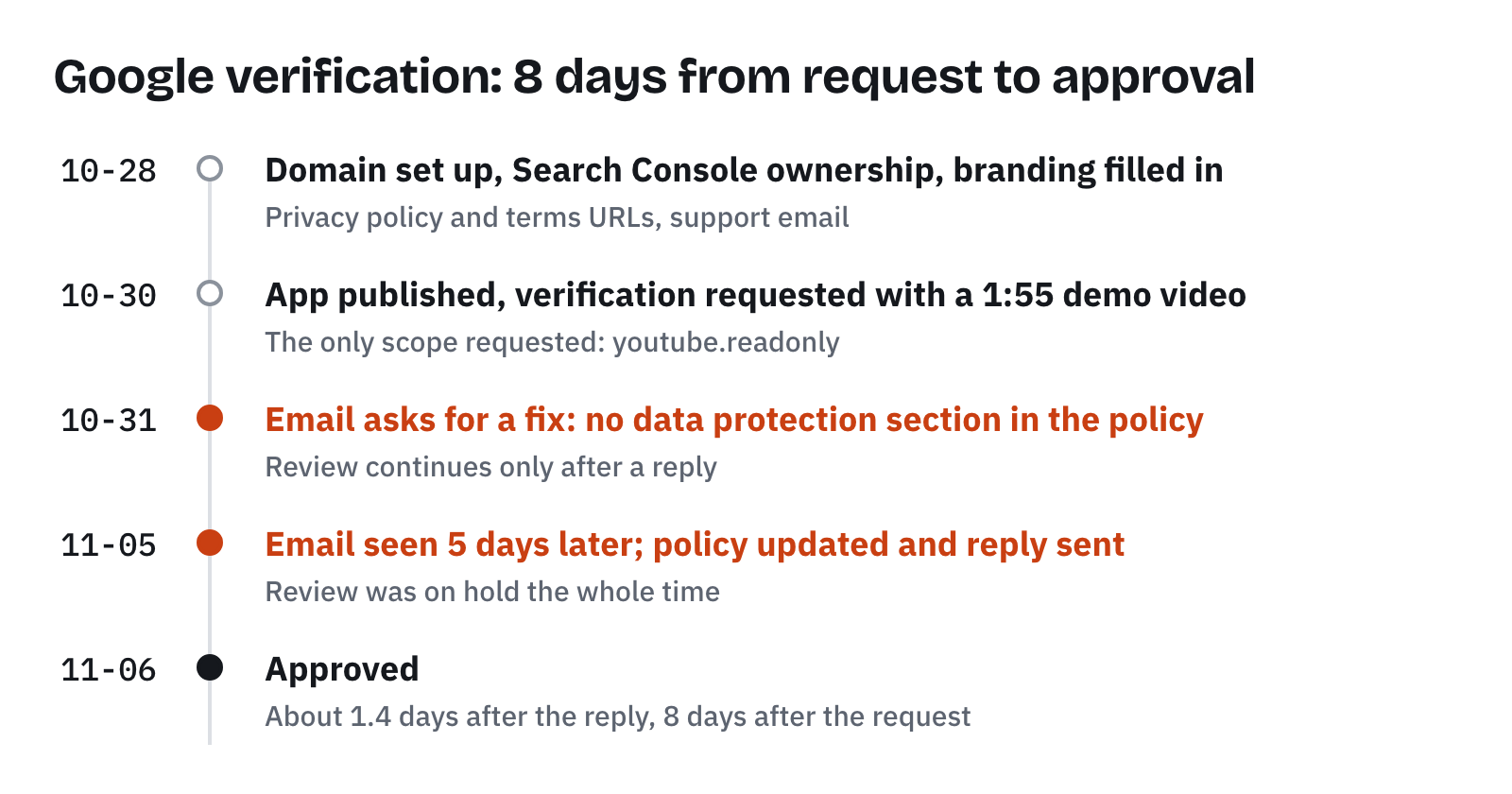
When I found out I'd missed the email, I thought, "I could have launched it a bit sooner." Looking back now, I don't think it mattered much. People didn't flood in during those 5 days, and in the end they came on the days I posted in communities. Since then I've set up notifications for emails from Google.
What I haven't figured out: promotion
In short: promotion turned out harder than I expected. I don't know how to do it well yet, and I can't tell what to stop doing.
Community posts brought people on the day I posted, and they dropped off after a few days. I can't keep posting in the same place, either. One developer community blocked me with a restriction on new accounts, and for the English-language communities the numbers barely show whether anyone is reading. dev.to and X got almost no reactions, but three weeks feels too early to call them useless.
What's next
In short: I'll keep posting blog posts and watch whether they actually bring people in from search.
The blog posts so far put phrases people actually search for in the titles, like "how to hide YouTube Shorts" and "how to turn off autoplay on YouTube." What I'm most curious about now is whether posts like these really bring people from search. Even if they don't bring a rush like a community post, I want to see whether they can become a steady way in.
Wrapping up
Not much grew in three weeks, but the biggest things were the first day someone else signed in and used it, and the comment that caught exactly why I built it. The questions I got changed how I describe Plainfeed and changed its code, and I'm still looking for an answer on promotion. In the next retrospective, I'll write down in numbers whether the blog brought people in from search.