82% of what my 3-minute Shorts filter caught weren't Shorts
Plainfeed is a website that shows new videos from the YouTube channels you pick, in upload order, without Shorts or videos chosen by YouTube's recommendation algorithm. It filters Shorts in two steps: if a video's RSS link is a /shorts/ link, it's out; and even if it isn't, anything 3 minutes (180 seconds) or shorter is out too.
Two weeks ago, 80% of the videos that rule caught were real Shorts. Measured the same way on November 26, it was 18%. 82% of what it caught were short regular videos, not Shorts. Breaking it down, I found the cause was how the videos were fetched.
A few terms first.
- RSS: the public file listing each channel's new videos. Plainfeed gets new videos mostly from it.
- Fallback: fetching a channel's upload list through the YouTube API (playlistItems) when its RSS fails.
/shorts/link: a video whose address in the RSS feed looks likeyoutube.com/shorts/…. I use it as the Shorts marker.- 3-minute rule: treating a video as a Short and leaving it out if its link is a regular one but it's 180 seconds or shorter. It only applies when the length is known, and live streams and their replays stay.
Why two steps
In short: the YouTube API has no "this is a Short" field, and Shorts can be up to 3 minutes, so I added a length check on top.
- The Data API's video details (videos.list) have no field that says whether a video is a Short. You get things like duration and live status.
- RSS often gives Shorts a
/shorts/link, so most of them can be filtered without an API call. - Since October 15, 2024, YouTube classifies square or vertical videos up to 3 minutes as Shorts (YouTube Help). So for Shorts without the marker, I added "3 minutes or shorter is out" as a safety net. Short live-stream replays stay.
// Filtering Shorts (trimmed, lib/youtube.js)
const SHORTS_MAX_SEC = 180;
const videos = feeds.flatMap((f) => f.videos)
  .filter((v) => !v.short)                                   // RSS link is /shorts/
  // … attaching duration and live status from video details is omitted
  .filter((v) => v.live || !(v.duration > 0 && v.duration <= SHORTS_MAX_SEC));   // 3 min or less (live stays)
How I measured
In short: I opened youtube.com/shorts/VIDEO_ID for random samples of the videos caught by the 3-minute rule.
As observed in November 2026, a Short opened at a /shorts/ address stays there, while a regular video redirects to the regular watch address (/watch). I classified each video by that difference. To check the method first, I tried 3 videos with /shorts/ links and 7 videos over 10 minutes long, and all came out as expected.
I only opened these in a browser while measuring (on November 12 and 26). It's page behavior, not an official API, so the service doesn't use it.
The two measurements
In short: about the same number of videos were caught by the 3-minute rule, but the share of real Shorts among them dropped from 80% to 18%.
| November 12 | November 26 | |
|---|---|---|
| Videos cached on the server | 2,554 | 8,529 |
Left out for a /shorts/ link |
640 | 2,949 |
| Regular link, but left out for being 3 min or less | 486 | 443 |
| Of a random sample of those, actually Shorts | 24 of 30 (80%) | 22 of 120 (18%) |
On November 26 I had first drawn a separate sample of 40, and 4 of them (10%) were Shorts. The two samples may overlap.
Splitting by how they were fetched
In short: none of the short videos fetched through RSS were Shorts, and every short video fetched through the fallback was.
Videos fetched through the fallback have no RSS link, so they can't get the /shorts/ marker. The code always stores them as "not a Short" with a view count of 0. So I used 0 views as the fallback marker and split the same sample of 120. An RSS video with genuinely 0 views could slip in, and "fetched through" here means how the channel was last fetched.
| Fetched through | Sample | Shorts |
|---|---|---|
| RSS | 98 | 0 |
| Fallback | 22 | 22 |
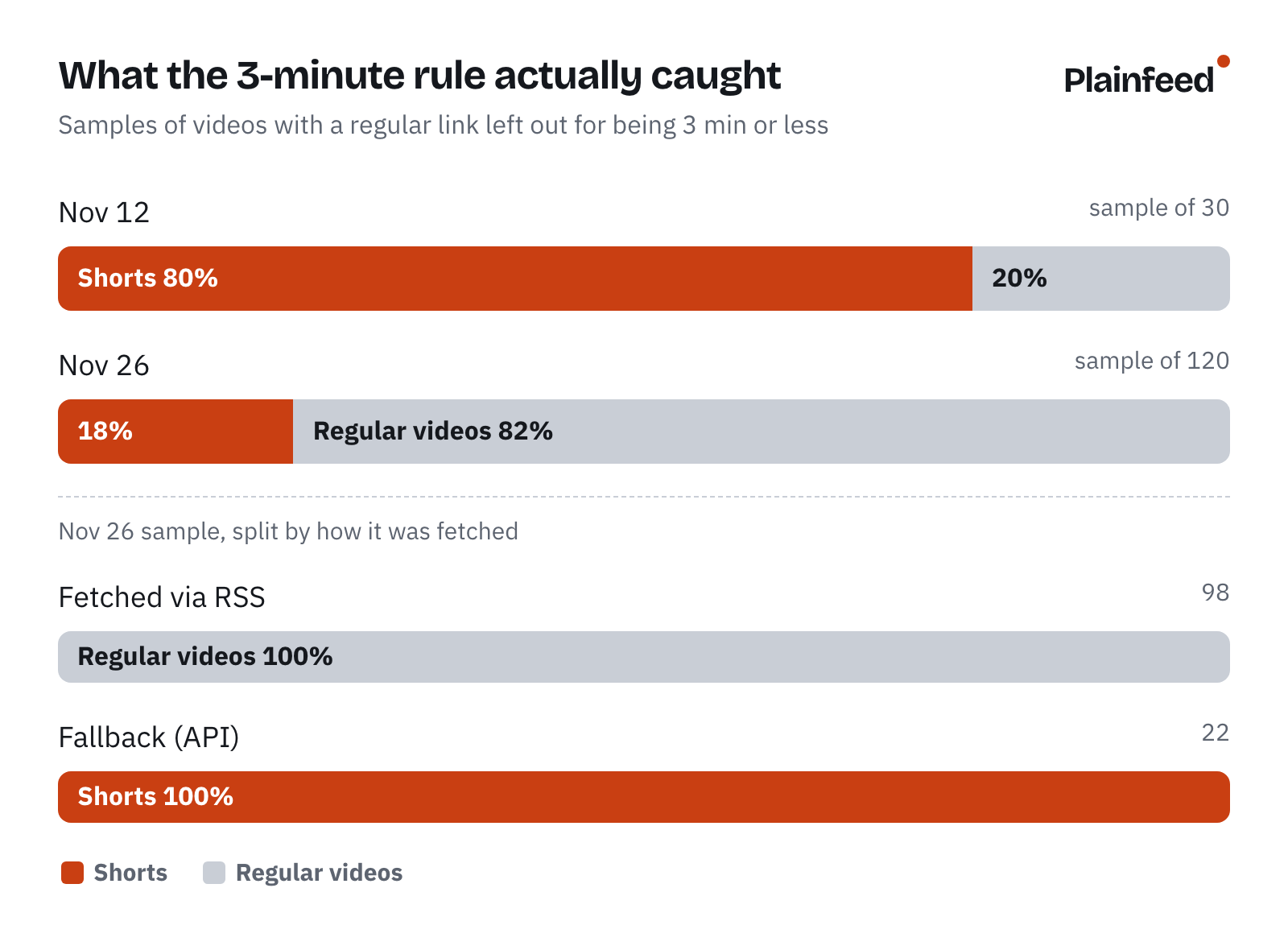
What this shows:
- Among videos fetched through RSS, no Short slipped past without the
/shorts/marker. It was 0 of 98 in the sample. A sample can't prove there are none, but any would be rare. - The only Shorts the 3-minute rule actually caught were fallback videos. Those can't carry the marker, so length was the only thing filtering them.
- The 80% on November 12 likely came from more fallbacks at the time. RSS was failing often that week, and on November 12 and 13 the server fell back for channels 106 and 234 times a day. When a fallback channel is later fetched through RSS again, the same Shorts get a
/shorts/link and drop out of the 3-minute list, so fewer fallbacks means a lower share. I didn't split by source back then, so I can't be sure.
What it was costing
In short: to stop 80 fallback videos (all Shorts in the sample), I was also leaving out about 360 short regular videos fetched through RSS.
Of the 443, 80 were stored with 0 views (fallback), and the other 363 came through RSS. Going by the sample, nearly all of those 363 are regular videos. So as of November 26, about 360 of the 5,580 regular-link videos were left out even though they aren't Shorts.
What changed
In short: since November 27, the 3-minute rule applies only to fallback videos.
- Videos fetched through RSS are filtered by the
/shorts/link only, and the 3-minute rule stays just for fallback videos. - Short regular videos now show up on the timeline, and Shorts are still filtered as before.
- I'll measure again to check the result.
Wrapping up
The rule looked right when I first measured it, so I left it. Measuring again showed the opposite. Looking at the totals alone, I would have just dropped the 3-minute rule. Splitting by how the videos were fetched showed where it's needed and where it isn't. The fallback itself is covered in When YouTube's RSS started returning 404 across channels.